 Ubud ATV Tours
Best Time of Year for an ATV Ride in Bali: Month-by-Month Guide
The best time for an ATV ride in Bali is May to September, when Ubud's dry season keeps the jungle tracks firmer and the rides run on schedule without the deepest mud of the year. April and October make a solid runner-up window, cooler on crowds than peak dry season with only a modest rain trade-off. November to March, the wet season, is the window to plan around rather than avoid outright, since every ride here runs rain or shine anyway. This guide checks Ubud ATV tours by season month by month, with the real rainfall numbers behind each verdict.
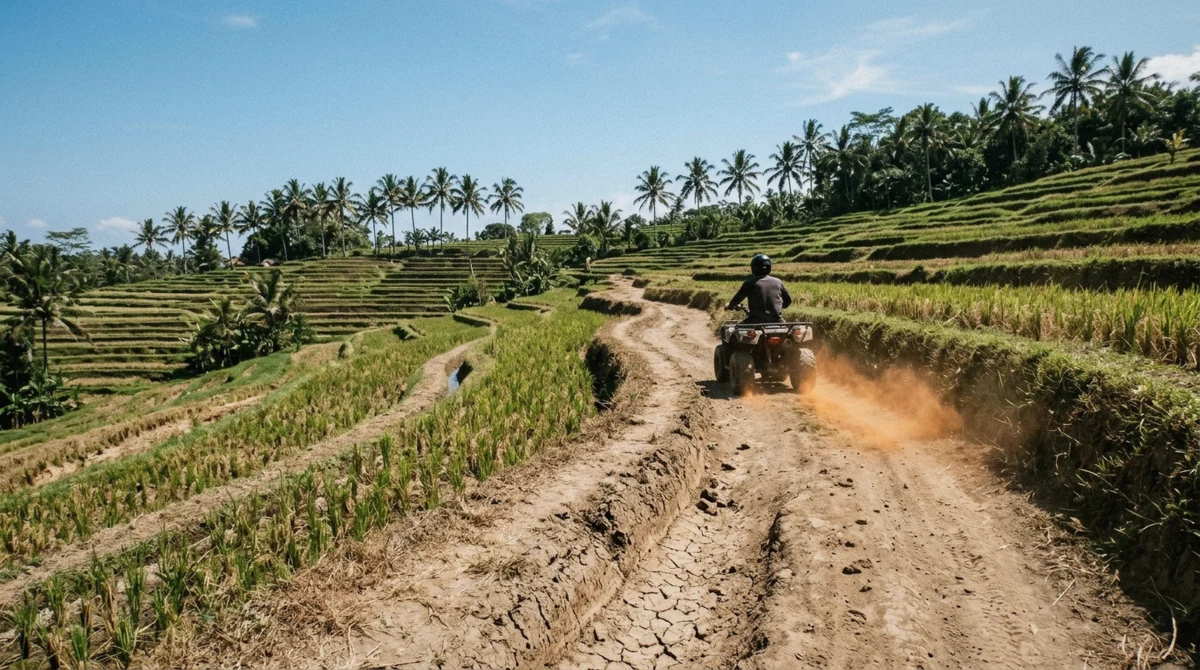
Quick answer The driest window, the wettest month, and the time of day that matters most
May to September is the best window for an Ubud ATV ride, when Ubud's driest months keep the track firmest. April and October run a close second with a small rain trade-off. Wet season, November to March, still runs every ride here, just muddier.
Key takeaways
- Best window: May to September, the driest stretch of Ubud's year
- Runner-up: April and October, cooler on crowds with a modest rain trade-off
- Month to plan around: January, the wettest at roughly 173 mm of rain across 21 rainy days
- Counterintuitive fact: the track stays roughly the same temperature all year, 29 to 31°C; the calendar changes the mud, not the heat
- Best time of day: morning, since Ubud rain typically falls as a heavy afternoon downpour
- Every listing runs rain or shine, and current Ubud quad bike prices don't change by season, only availability does
Seasons at a Glance
Read the Verdict column first, then the temperature and rainfall table underneath it for the actual numbers behind each call.
Month by Month, at a Glance
Every listing here operates year round, so the table below is a comparison of conditions, not availability. Verdicts are typical for the month, not a guarantee for any single day.
| Month | Track conditions | Weather | Crowds | Verdict |
|---|---|---|---|---|
| January | Deep mud, slower riding | Wettest month of the year | Low | Avoid unless you want the mud |
| February | Deep mud, slightly drier than January | Still peak wet season | Low | Avoid, wettest stretch |
| March | Softening track, mud easing | Wet season tailing off | Low to moderate | Late wet season, workable |
| April | Firming up | Shoulder month, occasional showers | Moderate | Good value, transitional |
| May | Firm and dry | Dry season begins | Moderate to high | Best overall begins |
| June | Firm and dry | Reliably dry | High | Best overall |
| July | Firmest of the year | Driest stretch | High | Best overall, busiest |
| August | Firmest, dustiest | Driest month | High | Best overall, busiest |
| September | Firm, starting to soften late month | Dry season tailing off | High | Best overall |
| October | Softening | Shoulder month, rain returning | Moderate | Good value, transitional |
| November | Mud returning | Wet season begins | Low to moderate | Shoulder into wet, workable |
| December | Deep mud | Wet season established | Moderate (holidays) | Avoid, mud and holiday crowds |
The pattern is straightforward: May to September is the driest, firmest run of months, November to March is the wettest, and April and October sit in between. December's crowd bump comes from the holiday period rather than conditions, which is the one month where the trap is people, not weather.
Temperature and Rainfall Through the Year
Rainfall figures are station averages for Ubud, sourced from weatherandclimate.com; treat every number below as typical for the month, not a promise for your specific dates, and figures do vary a little between climate sources.
| Month | High (°C) | Rain (mm) | Rainy days |
|---|---|---|---|
| January | 30 | 173 | 21 |
| February | 30 | 148 | 19 |
| March | 31 | 160 | 20 |
| April | 31 | 126 | 18 |
| May | 31 | 59 | 12 |
| June | 30 | 25 | 7 |
| July | 29 | 19 | 4 |
| August | 29 | 8 | 2 |
| September | 30 | 17 | 4 |
| October | 31 | 35 | 8 |
| November | 31 | 68 | 16 |
| December | 30 | 127 | 20 |
By the numbers, August is the driest month at about 8 mm of rain across 2 rainy days, and January is the wettest at around 173 mm across 21 rainy days. Daytime highs barely move across the year, staying in the 29 to 31 degree range, and humidity holds at 82 to 85 per cent regardless of season, which is the reason nothing you wear dries mid-ride whichever month you book.
Tours to Book Around These Windows
The listings compared here run year round; these three cover the range from firm dry-season tracks to the deeper wet-season routes.

Gorilla Adventures Jungle ATV Ride with Lunch
The one 6,750 riders have reviewed. A guide rides with your group over jungle track, rice fields, river crossings and tunnels for an hour and a half, then you shower off the mud and sit down to fried rice at the base. Solo or tandem, hotel pickup optional. Guides here also work in French and Indonesian.
- Cancellation
- Free cancellation 24h
- Operator
- PT. Gorilla Adventures Bali

Gorilla Face Cave ATV Ride with Lunch
Same operator and same base as the jungle ride, different headline: a rock face carved into the shape of a gorilla, with a tunnel that spits you out of its mouth. It photographs better than it rides — reviewers rate the guides 4.9 but call the course itself short and a bit repetitive, so book the tandem only if you are happy sharing 1.5 hours of saddle time.
- Cancellation
- Free cancellation 24h
- Operator
- PT. Gorilla Adventures Bali

Jungle, Waterfall and 750 m Tunnel ATV Tour
The track with the real cave: 750 metres of natural tunnel, plus river crossings, cliff-edge jungle and a slide under a waterfall. It is the strictest listing on limits — 12 to self-drive, roughly 135–140 kg combined per quad, and a 30-minute registration cut-off that will genuinely bump you to the next departure if you are late.
- Cancellation
- Free cancellation 24h
- Operator
- Potato Bali Tours & Activities
Best Season by Rider Type
If You want the driest, firmest track
book May to September, and July or August specifically if dust and heat don't bother you.
If You're a first-timer worried about cancellation or a washed-out ride
the dry season, May to September, is the safest bet, since it's the window least likely to hand you a deep-mud surprise.
If You're travelling on a tighter budget and want thinner crowds
April or October give you most of the dry-season firmness with fewer other riders on the track.
If You actually want the mud, not despite it but for it
November to March delivers the deepest track conditions of the year, and every listing runs rain or shine anyway.
If You're chasing the best photos
book a morning slot in the shoulder months, when the light is softer and the track isn't yet at its driest, dustiest state.
May to September: The Dry Season
This is the firmest, most predictable window of the year on every track compared here. Daytime highs run 29 to 31°C, rainfall drops to single digits or low double digits in millimetres by July and August, and rides run close to their listed 1 to 1.5 hours without the slower going that deep mud adds.
- Real numbers: 8 to 25 mm of rain a month from June through August, 2 to 7 rainy days
- Crowds: high, particularly July and August, Bali's peak international travel months
- Price signal: no seasonal price change on the listings themselves, but book ahead as slots fill faster
- Booking lead time: a few days ahead in the driest months is a safer margin than a same-day booking
The honest trade-off: firmer ground means less of the splash and mud-spray that reviewers across every listing single out as the fun part. The jungle ATV ride still runs its river crossings year round, dry season or not, so the core experience doesn't disappear, it just runs a little tamer. If firmer, drier conditions are the deciding factor between booking now and waiting, the honest case for an Ubud ATV ride walks through the trade-offs that matter beyond the calendar.
November to March: The Wet Season and the Deep Mud
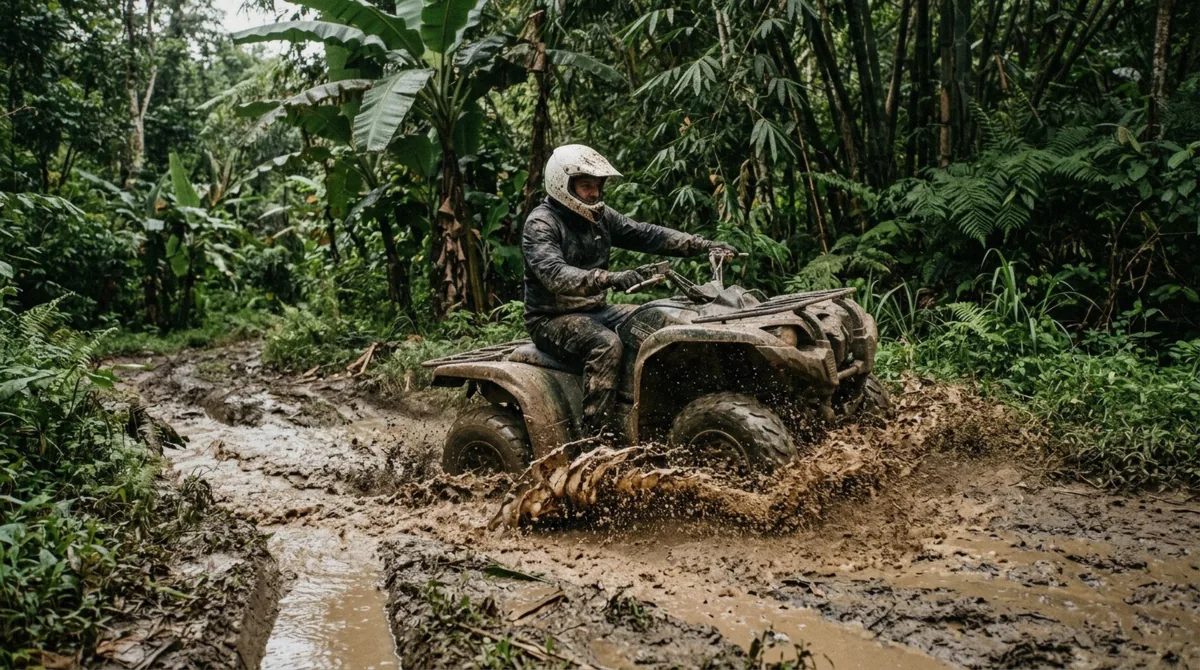
Bali's wet season runs roughly November to March, and it is genuinely the muddiest window for these tracks, not a minor variation on the dry-season experience. January is the wettest month at about 173 mm of rain across 21 rainy days.
- Real numbers: 68 to 173 mm of rain a month, 16 to 21 rainy days
- Crowds: low to moderate outside the December holiday weeks
- Price signal: no seasonal discount on the listings, but thinner crowds mean easier slot availability
- Booking lead time: same-day or next-day booking is realistic outside the holiday period
Every listing here runs rain or shine, and operators describe the wet track as more fun and more challenging, not a diminished version of the dry-season ride. The trade-off is genuinely deeper mud, slower going through river crossings, and a longer session with the towel and hot shower afterward. Rain in Ubud usually arrives as a heavy afternoon downpour rather than an all-day drizzle, which is why the morning slot is the reliable choice in these months.
Pack accordingly; see what each Ubud ATV tour provides for the full gear list.
April and October: The Shoulder Months
These two months split the difference: rainfall in the 35 to 126 mm range, well below the wet-season peak but higher than the dry-season floor.
- Real numbers: October averages 35 mm across 8 rainy days; April averages 126 mm across 18 as the wet season only just finishes tailing off
- Crowds: moderate, noticeably thinner than July and August
- Price signal: no listing-level price change, but easier last-minute availability than peak dry season
- Booking lead time: a day or two ahead is comfortable in October; April runs closer to wet-season booking patterns
October is the better of the two shoulder months for a first-time rider chasing dry-season conditions without dry-season crowds. April sits closer to the wet season in practice, since the rain hasn't fully cleared yet even as the calendar turns.
The Best Month If You Only Have One Morning
For a tightly scheduled trip with one shot at this, three months earn a place on the shortlist, each for a different reason.
- August, the driest month outright, firmest track, but the busiest slots of the year
- October, nearly as dry as peak season with noticeably thinner crowds
- June, reliably dry without August's dust and peak-season booking pressure
The Worst Time to Ride, Honestly
January is the honest answer: the wettest month of the year at roughly 173 mm of rain across 21 rainy days, with the deepest mud and the slowest going on every track. It still works for a rider who specifically wants that, the deepest splash and the most dramatic river crossings, and reviewers who ride in the wet months describe exactly that as the highlight, not a disappointment. It's the wrong month for a first-timer hoping for a clean, predictable ride, or anyone travelling with a nervous rider who'd rather ease in on firmer ground.
Best Time of Day
Morning is the recommendation, and it holds across every season, not just the wet months. Ubud's afternoon heat builds through the day, and in the wet season the heavy rain typically arrives in the afternoon rather than the morning, so an early slot gets you the calmest conditions available on any given date. The one exception is a photographer chasing dramatic light through the canopy, where a later-morning slot can work once the sun has cleared the tree line without yet hitting full midday intensity.
A morning departure on the jungle ATV ride is the straightforward default for most riders.
What Happens If It Rains
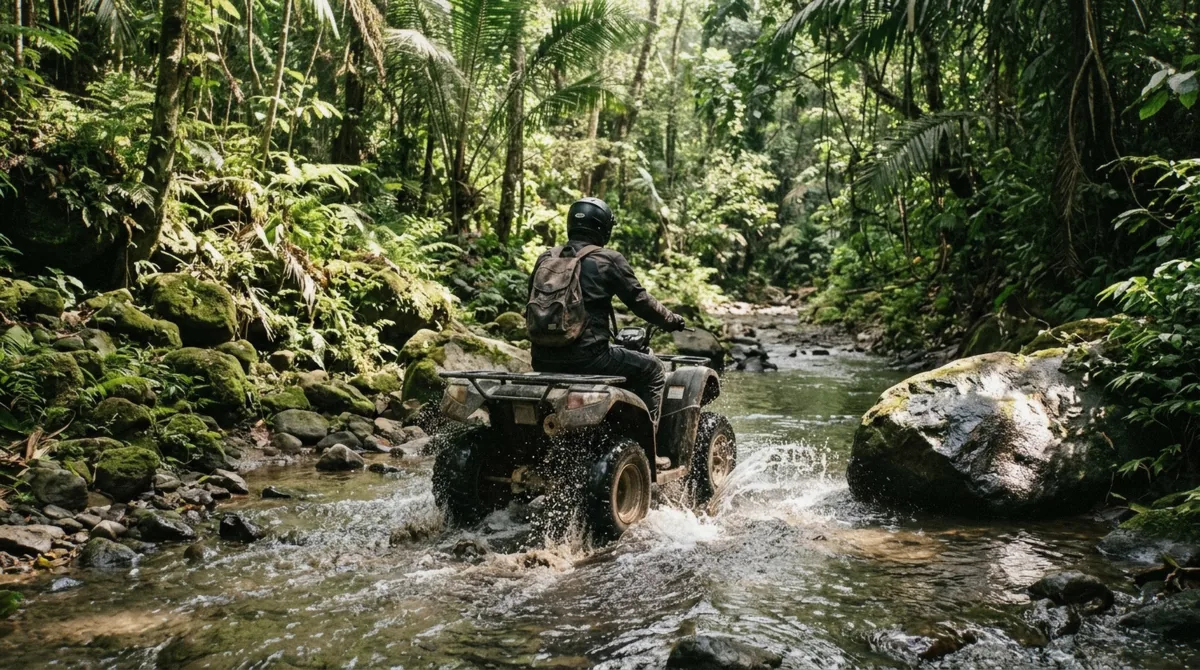
Every listing here runs rain or shine; light rain doesn't cancel a ride, and only extreme weather does. Refunds and rescheduling follow the standard policy on every listing: free cancellation up to 24 hours before the ride, so a forecast that turns is a manageable problem rather than a lost booking if you act ahead of that window. A spare morning built into your itinerary is the practical hedge for anyone travelling in the wetter months.
So, When Should You Ride?
May to September is the best window for an Ubud ATV ride, the driest and firmest stretch of the year, with July and August as the peak of that. April and October are the budget-conscious runner-up, most of the dry-season benefit with thinner crowds. January is the month to avoid if a clean, predictable ride matters more to you than the deepest mud of the year.
Whichever month you land on, the tracks compared here in the Ubud ATV listings and their age limits, gear guide and price comparison all stay the same, only the mud changes.
Best Time for ATV Bali: Questions
What is the best month for an ATV ride in Ubud?
May to September, the driest stretch of Ubud's year, with July and August the firmest and busiest of that window. April and October make a solid runner-up with fewer crowds.
Is an Ubud ATV ride good in the wet season?
Yes, with a real trade-off: November to March brings the deepest mud of the year, and January is the wettest month at around 173 mm of rain. Every listing here still runs rain or shine, and operators describe the wet track as more fun and more challenging rather than a compromised ride.
How far in advance should I book an Ubud ATV tour?
A few days ahead in peak dry season, July and August, when slots fill fastest. Outside those months, and especially in the wet season, next-day or even same-day booking is realistic.
When is the rainy season in Bali?
Roughly November to March, against a dry season running May to September. April and October sit in between as shoulder months.
Morning or afternoon, which is better for an ATV ride?
Morning, in every season. Ubud's rain in the wetter months typically falls as a heavy afternoon downpour, and afternoon heat builds through the day year round, so an early slot gets the calmest conditions available.
When are Ubud ATV tours cheapest?
Prices don't change by season on the listings compared here; what changes is how easily you can get the slot you want. Wet-season months and the April and October shoulder period offer easier last-minute availability than peak July and August.
What happens if my ATV tour gets cancelled for weather?
Every listing here runs rain or shine, with only extreme weather stopping a departure, and free cancellation applies up to 24 hours before the ride if your plans change ahead of a forecast.
The bases sit in the Payangan and Tegallalang areas, roughly 20 to 30 minutes from Ubud town, and the calendar changes what happens on that valley track more than it changes anything about getting there. Firm and dusty in August, deep and dramatic in January, the ride itself runs every month of the year. Once your dates are fixed, which Ubud ATV ride fits them is the next question, and the answer changes with the pickup area more than with the month.